Changing Watch Schedules at Sea
Because of the change in
longitude each day, time must be added on a westbound voyage and subtracted on
an eastbound voyage. For the passengers, only one time change is made each
night (near midnight) to a master clock controlling slave clocks located in
various public places. The adjustment made is such that at local apparent noon
the next day the clocks would read 12:00. However, for the crew that stand
regular sea watches, it is not that simple.
WESTBOUND
CROSSINGS
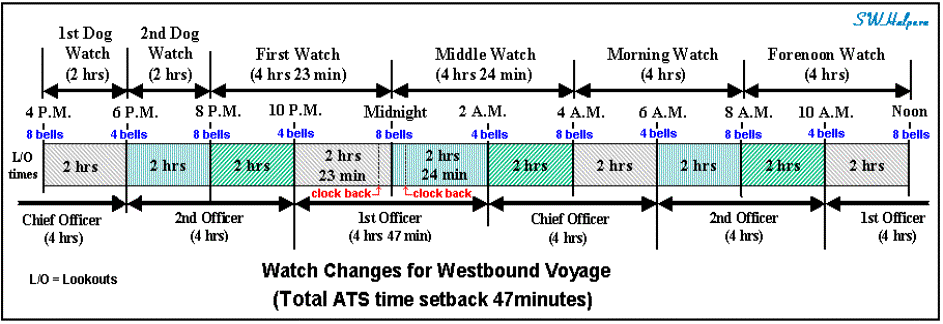
For a westbound crossing extra time must added to the
watch schedules of the deck department crew and engine department crew. The
rationale developed for the westbound voyage is that the total extra time to be
added would be split equally between the two watch sections of the deck
department crew (as well as between two of the watch periods kept by the
lookouts) in two separate clock adjustments as pointed out by QM Robert
Hichens. These adjustments can be shown graphically. The diagram below shows
the period of time from the start of the First Dog Watch (at 4 p.m.) to the end
of the Forenoon Watch (at noon). The deck crew watches, the watch periods of
the lookouts, and the Senior Officer watches are all indicated. Time on
clocks keeping Bridge Time, used by the deck department and engine department
crew, are indicated in a.m./p.m. format. Lookout watches are shaded
showing the three pairs of lookout assignments. A total setback of 47 minutes
(as planned for the night of April 14, 1912 on Titanic) is assumed in the
westbound example shown.
EASTBOUND CROSSINGS
For an eastbound crossing the total adjustment time
was to be subtracted from watch schedules of the deck department and engine
department crew. Simplicity is foremost, and on eastbound crossings only one
time adjustment was needed to reduce half the time served by the 8 p.m. to
Midnight Watch and by the Midnight to 4 a.m. Watch. Again, this can be
seen graphically in the diagram below from the start of the First Dog Watch to
the end of the Forenoon Watch. A total advancement time of 44 minutes is
assumed in this example as was the case on the night of July 01, 1911 on Olympic's
maiden eastbound crossing.

|
To follow these time adjustments in tabular form, as
well as see the various watch schedules for the |
HOME << BACK TO Titanic CHARTROOM